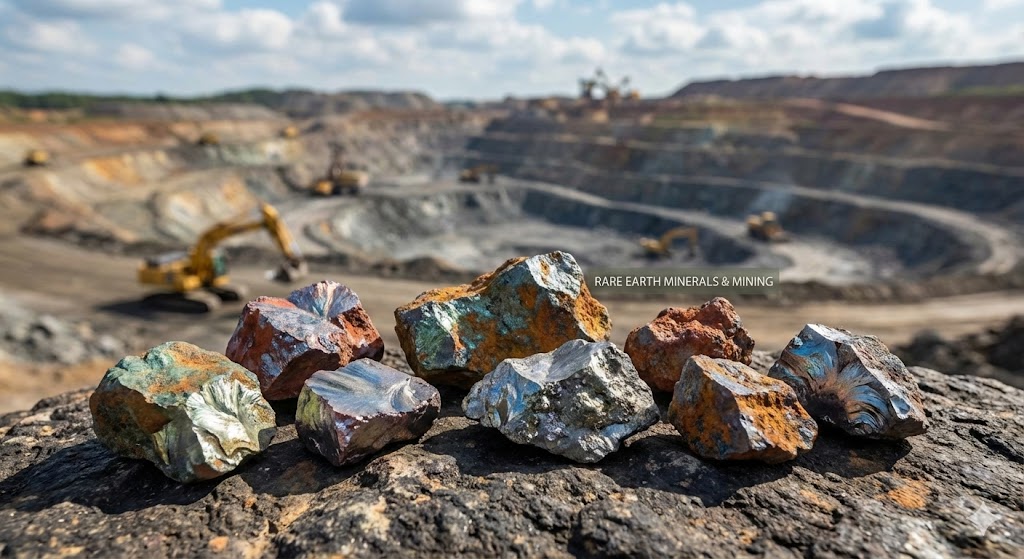
I'm a simple guy, who loves sports, tech, and going on as many vacations as possible—but like you, I've been a complete nerd lately trying to wrangle the information coming in from the AI firehose. In this article, we'll talk about the origins of AI, the actual specs of dirt and minerals buried in the earth that become part of the AI revolution that I believe will change everything, in fact, it's already happening.
Not all dirt is created equal. For example: The red clay dirt I grew up with in Oklahoma is far different than the sandy marsh dirt in Florida. Where these materials come from and who controls them is where things get interesting. There are four materials the AI revolution needs: Silicon, Gallium, Germanium, and Graphite. Remember these four materials. They are the AI gold and they are changing everything.
> If you dabble in the market, I've added a few key players at the end of this article to help get that Robinhood account moving.
Now, for the most part, mining these materials generally runs the same process. That is, you dredge the sea or dig into quarries or mountainsides, scoop some sand, then wash, sieve, crush, or heat it to achieve a level of purity.
Silicon: The Foundation
Silicon seems to have the biggest requirement of purity of the 4. It's refined or smelted to a purity of 99.999% or higher. Next, it's time to melt what's left over into what's called an Ingot. Essentially, if I took a sand bucket to the beach and filled it with sand by the time I get to the process to create the Ingot, we've already lost 60% of the sand in the bucket.
I found this process to be fascinating. Essentially, we heat the remaining 40% of sand up at roughly 2,588º F and drop some sort of magic wizardry seed crystal in the sand that causes the silicon to freeze on the seed forming a crystal. This is called the ingot. This process takes enormous amounts of energy. Take note of this, energy is incredibly important in our learning.
Now that we have the ingot, we're going to take out our Sam the Cooking Guy Chef knife and slice and dice this bad boy into 1mm slices of wafers. Not the eating kind of wafers unfortunately (anyone else remember Vanilla Wafers?). These wafers are then inspected like a TSA super bot and shipped off to the fabrication facility where they go through a gazillion processes. The key one being Etching & Doping, where unwanted material is etched away to leave the circuit pattern that helps power your vibe coded to-do list app.
Gallium: The Premium Alternative
If Silicon is the Winn-Dixie of the world, Gallium is the Sprouts. Gallium chips are an alternative to silicon chips. They outperform, are faster charging, smaller in size and is the material used to enable blue and white light used in screens. Think of it this way, next time you turn "night mode" off on your phone, remember, you just turned off the Gallium. That's not all. Gallium is vital for 5G and 6G because it has higher data frequencies which allow you to transfer more data. AOL has entered the chat…
Gallium is basically a child of Aluminum. Unlike silicon, gallium is not "scooped up". It's a byproduct of Aluminum Refining and Zinc Smelting. A gallium wafer is much more expensive and over 98% of the production is concentrated in China. I'm remembering all the news talk about Apple moving a large portion of its production of the iPhone back to the US and to India. Obviously having the manufacturing infrastructure in place is a big deal, but now you can understand why this is even more problematic. China owns all the material that makes their product.
Here's another stat: NVIDIA's chips - the new Blackwell and Rubin - are 100% silicon. Gallium chips are used in things like 5G/6G towers, EV charging systems, and military applications. So why wouldn't NVIDIA go all in on gallium?
While everyone wants the new Air Jordans, sometimes the New Balance lawn shoes just hit different. Here's the nerdy reason: silicon easily bonds with oxygen to create silicon dioxide (SiO2), an insulated layer that forms a very stable home on the wafer for billions of tiny transistors needed for complex AI "reasoning" and processing.
Think of a transistor like an on/off light switch. The more switches you have in a small space, the more complex things your computer chip can do. The only way to get billions of them onto a single fingernail-sized chip is by making them incredibly small using silicon wafers. Gallium and other material cannot form a good enough layer as easily as silicon. Economically, where silicon might cost hundreds of dollars, gallium costs thousands making silicon the only commercially viable choice for consumer applications.
Germanium: A Fascinating History
Ok, so silicon seems to be the standard and is everywhere, gallium seems to be the upgrade, but it's controlled by one nation and is harder to scale, what about Germanium?
Germanium has a fascinating history. Like gallium, germanium is a byproduct of extraction from zinc ores (roughly 75%) and coal. Similar chemical processes, smelting and roasting all lead to purifying the material into the highest purity of metal. One stat I found interesting; roughly 30%-35% of the global supply of germanium is recovered from recycling! This fact might come in handy as we dive deeper into this series.
Here's a brief history on why germanium matters to your N8N and Claude Code web scraping weekend project. Back in 1947, germanium was used to build the world's first transistor called the point-contact transistor and it changed the microelectronic world forever.
Why isn't germanium the king of your AI marketing agent, you ask? After all, electrons move faster through germanium than they do silicon which means a germanium transistor can switch "on" and "off" faster than a silicon one. Therefore, better for 5G/6G? Fiber Optics? Well, Sort of.
Germanium, like gallium, has a smaller "Band Gap". Not to be confused with the Gap Band (what a career they had). The band gap is essentially the playing field where the computing actually happens. Silicon has the biggest band gap, whereas germanium has a smaller field and has electrical current leaks in the band gap.
I think of this as a good bartender vs. a bad bartender. The good ones can cover the entire bar (band gap) and can flip bottles and blow fire without spilling a drop (leaks) of your espresso martini. Whereas germanium is the local bartender who stands in one spot and has a spill sheet next to the register (bartenders understand this). Oh, and don't forget about the silicon dioxide layer – yeah, germanium can't do that well either.
Graphite: The Unsung Hero
There's one last material we need to talk about. Graphite. Yes, the #2 pencil you use, that graphite. Today, graphite has shifted its focus to be the essential backbone of battery technology. Roughly 90% of lithium-ion battery anode is made of graphite. This surely could be a topic for another rabbit hole, so we'll focus on what it means to the weekend hackathon at YCombinator that had hundreds of vibe-coding crazies pumping out everything from productivity tools, companion apps, UGC videos, and more.
Graphite is to the mineral mining process as oil is to a lawn mower. Each is incredibly important to the output of a larger process. Graphite is used to assist melting silicon into the ingot crystals we mentioned earlier. It's also key for wafer production, ion implanting (the process that puts atoms on chips to give it one electrical property or the other) and more. It's essential to many key processes as we go from sand to chip.
While graphite is mined in the conventional fashion; there's also a surge of synthetic graphite and despite it being significantly more expensive and energy-intensive to produce than natural graphite it comes down to one simple fact. Purity.
Semiconductor manufacturing is a "zero-margin-for-error" environment. Even microscopic impurities can ruin an entire batch of silicon wafers. Natural graphite can contain microscopic elements of iron, sulfur, and more. If this material gets onto the wafer, it's toast. Now I like toast just as much as wafers but in this case, you can think of it more like burnt toast. The kind you throw away.
Synthetic graphite is engineered from petroleum coke and is 99.999% pure carbon, eliminating the risk. Other factors allow manufacturers to forecast properties of synthetic graphite which allow them to streamline production processes. So, while natural graphite costs less and consumes less energy; synthetic graphite costs more, uses more energy, but has a near-zero failure rate. Which saves money and energy over time.
Material Comparison
There's an entire rabbit hole we can get into around the energy to conduct electricity in each of these materials and the costs for producing these materials. Here's a chart to give you an idea and one we'll reference later in this 6-part series:
| Metric | Silicon | Gallium | Germanium | Graphite |
|---|---|---|---|---|
| Energy to Mine/Produce | High energy for purification (100+ kWh/kg) | High energy for refining, but byproduct | Very high energy for high-purity refining | Highest. Synthetic requires heating to 3,000°C for weeks |
| Cost to Mine/Produce | Low cost for raw material. High cost for ultra-pure final product | Most expensive per kg (~$500-$2,280/kg) | Expensive per kg (~$1,000-$2,653/kg) | Lower for natural, higher for synthetic ($10-$20/kg) |
| Richest Deposits | Abundant globally (Quartz) | China (98% of production) | China (60-83% of production) | China (60-79% of production) |
It's also clear; the sand beneath our feet and thousands of miles below the earth's surface play a major role in AI and just as the Land Run of 1889 played a major role in settlement. The sand or dirt you claim is worth more than anyone imagined. It's also clear that there are 2 important aspects of this part of the supply chain. The land to mine the minerals and the refining process to produce usable material. So, who are a few key players that control the dirt?
Key Players
| Material | The Western "Hope" (Non-China) | The Real Global Giant (China) |
|---|---|---|
| Silicon | Hemlock (USA), Ferroglobe (EU) | Tongwei, GCL Tech |
| Gallium | N/A (Almost entirely recycled by Umicore/Japan) | CHALCO (Aluminum Corp of China) |
| Germanium | Teck Resources (Canada) | Yunnan Germanium |
| Graphite | Syrah Resources (Mozambique/Australia) | BTR New Material, Shanshan |
I have no affiliation to any company listed. They've only surfaced during my research. Nothing more. Nothing less. Take it for what you will.
What's Next
Next, we need to move the material from point A to point B, so it's manufactured. If silicon is widely available, but China owns nearly all the production of gallium, production of germanium, and production of graphite, what does this mean for imports and exports?
In the next article, we'll dive into the global shipping and geopolitical aspects that impact how this "sand" ends up being a major player in your unicorn SaaS app. We'll get a bit nerdy into the politics, tariffs, and international law. Did you know that China recently banned the export of key materials such as gallium and germanium? What impact does this have on tariffs and how will the US continue to be a leader in AI without the sand and dirt that makes it all possible?